

- Places
- 3 places
- GPA minimum
- Aucun
- Surcoût
- 0 €
- Durée
- Semestre
- Langue des cours
- Anglais
- Erasmus+
- Non
- Diplôme délivré
- Non
Pour moi
Remplis ton profil pour savoir si cette université te correspond.
Enregistré sur cet appareil. Connecte-toi pour le retrouver partout.
Spécialités
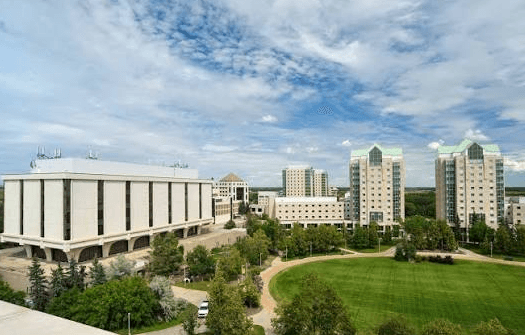
L'Université de Regina (U of R) dispose de campus à Regina et à Saskatoon, sur les territoires du Traité n° 4 et du Traité n° 6. Ce sont les terres ancestrales des nêhiyawak (nay-hi-yuh-wuk, Cris), des Anihšināpēk (uh-nish-i-naa-payk, Saulteaux), des Dakota, Lakota et Nakoda, ainsi que la terre natale de la Nation métisse/michif.
Université pluridisciplinaire, la U of R trouve ses origines dans le Collège de Regina, un petit lycée-internat créé par l'Église méthodiste en 1911. Le collège a gagné en taille et en importance, devenant un campus de l'Université de la Saskatchewan, puis, en 1974, une université indépendante habilitée à délivrer des diplômes : l'Université de Regina.
Regina est la capitale de la Saskatchewan et la 16e plus grande ville du Canada, avec 226 404 habitants. Regina est située dans le centre-sud de la province. La ville s'étend sur une superficie de 182,42 kilomètres carrés. Elle se trouve au milieu des provinces des Prairies, avec l'Alberta à l'ouest et le Manitoba à l'est. Elle est frontalière des États américains du Montana et du Dakota du Nord.
Calendrier universitaire
Semestre d'hiver : de début janvier à fin avril
Plus d'information sur le calendrier académique ici
Crédits
Pour obtenir vos 60 ECTS, vous devrez valider 12 crédits locaux pendant votre semestre à l'étranger.
1er semestre (septembre - décembre) : stage de 4 mois à temps plein (20 ECTS) + participation à des activités complémentaires en ligne (10 ECTS). Commencez votre recherche de stage le plus tôt possible.
2nd semestre (janvier - fin avril) : vous devrez suivre 12 crédits locaux afin de valider les 30 ECTS restants.
Cours
Les cours sont enseignés en anglais. La liste des cours ci-dessous ont été validé par Epitech. Si vous êtes intéressés par d'autres cours qui ne sont pas mentionnés, merci de contacter l'équipe des Affaires internationales d'Epitech.
Vous pouvez également faire une recherche des cours disponibles via ce lien
Nom du cours | Description | Prérequis |
|---|---|---|
Introduction to Programming with Python | An introduction to problem-solving techniques using Python. This course will introduce fundamental programming principles and topics: data types, expressions, control structures, elementary data structures, functions, files, and the mechanics of running, testing and debugging. These concepts will be applied to problem solving and applications in data analysis. | Foundations of Mathematics 30, Precalculus 20, Math B30, Math C30, or PMTH 092. Students may receive credit for one of CS 165 or STAT 165 |
Introduction to Digital Systems | Hardware paradigms, logic minimization, sequential and combinational circuits, register transfer notation. Numerical data representation, number bases, floating-point and two’s-complement representation, representation of non-numeric data, records and arrays. Von Neumann architecture, control units, instruction sets, assembly language programming, addressing modes, subroutines, basic building blocks, computer components | |
Java Programming and Applications | Learn to program in the Java programming language. Topics will include the basic building blocks of procedural programming, object-oriented programming, event-oriented programming, graphical user interfaces, simple data structures including arrays and linked lists, and advanced topic including recursion and threads. Problems will be drawn from various science and engineering disciplines. | |
Introduction to Multimedia Systems | Multimedia is the use of computers to integrate texts, graphics, video, animation, and sound in an interactive experience. The course introduces these elements of multimedia and their associated technologies. Students will gain an appreciation of each element and be able to combine them into a finished work. | |
Building Interactive Gadgets | An introduction to building and controlling interactive devices for multimedia art and DIY projects. Build robots, new musical instruments, wearable computers and more. Learn about sensots and actuators: WiFi, Bluetooth, GPS; hardware platforms such as the Arduino; and software platforms such as Processing and MaxMSP. | |
Data Structures and Abstractions | This course introduces data abstraction, data structures and their implementations, the basics of algorithmic analysis, and the fundamental computing algorithms. Topics include stacks, queues, heaps, recursion, Master Theorem, asymptotic notation, computational complexity, empirical performance measurement, recursion based sorting algorithms, hashing, and trees (including binary trees, B-trees, and AVL trees). | |
Web and Database Programming | This course shows how interactive database-driven web applications are designed and implemented. Appropriate protocols and languages for web and database programming will be discussed, with a focus on client-server architectures, interface design, graphics and visualization, event-driven programming, information management, data modeling, and database systems. | |
Methods in Numerical Analysis | Topics will include number systems and errors, solutions of polynomial and other nonlinear equations, interpolation, numerical differentiation and integration, and the cubic spline. | |
Introduction to Data Science | This course introduces data science including current programming languages and libraries for performing data analysis. Topics include data exploration and preparation, data visualization and presentation, computing with data, and an introduction to data modeling and predictive analysis. Technical and communication skills used by data scientists will be introduced. | |
Risk and Reward in the Information Society | Social context of computing. Case study: human-computer interfaces and their evaluation. Methods and tools of analysis. Professional and ethical responsibilities. Risks and liabilities of computer-based systems. Intellectual property, privacy and civil liberties. Professional communication. Sustainability. Cybercrime. | |
Intro to Digital Multimedia | This course will focus on digital graphic and website design students will learn industry standard and motion graphic software packages: Adobe Photoshop & Premiere, Flash MX, Dreamweaver MX. Students will participate in problem-solving environment using timelines. Projects will require good design concepts and an understanding of multimedia software packages. | |
Java Programming Language | Introduction to Java (based on an instructor-led Sun course offered in industry). The course covers topics such as arrays, exceptions, GUI interfaces, GUI event handling, Threads, I/O streams and Networking. | |
Topics in Societal and Ethical Considerations | This course will involve exploration of various considerations of computerized society and what it means to be a professional therein. The student will examine the history of computing, the history of the computing profession, Ethics of professional conduct, intellectual property, and computer crime, among other topics of interest. | |
Computer Technology for Live Performance | Exploration of the way computer technology can impact various aspects of the performing arts (specifically live theatre, dance, and concert environments for the performing arts (specifically live theatre, dance, and concert environments) including lighting, sound, props and set design as well as projection mapping, virtual/augmented reality, and interactive performance. | |
Topics in Data Acquisition and Analysis | Introduced to data collection techniques by developing their own sensor modules, running experiments and verifying the results. Students will learn microcontroller programming for data collection as well as regression techniques and error analysis for calibration and verification. Potential modules developed range from simple light sensors to fully functioning geiger counters. | |
Introductory Topics in Artificial Intelligence | A course in special topics in which the student makes an independent study in Artificial Intelligence at the second-year level under the supervision of a faculty member in the department. | |
Introduction to Computer Graphics | Introduction to graphics hardware and software. Two-dimensional graphics rendering algorithms. Basic three-dimensional modeling, transformations, viewing geometry, lighting and shading, hidden surface removel, and texture mapping. | |
Introduction to Artificial Intelligence | Foundations and main methods of Artificial Intelligence. Problem characteristics and spaces. Search and optimization techniques with a focus on uninformed and heuristic algorithms. Two player games and constraint satisfaction. Modelling and simulation. Comparison of logic-based, fuzzy, and probabilistic reasoning and knowledge representation methodologies. Machine learning: learning tasks, inductive learning, statistical-based learning, over-fitting, accuracy. | |
Introduction to Operating Systems | Overview of operating systems: functionality, and design issues. Operating system principles: structures, abstractions, APIs, resource allocation, proximity, virtualization. Concurrency: process state, context switches, process communication, synchronization. Scheduling: preemption, schedulers, processes, and threads. Memory management. Security and protection. File systems. User interface. Distributed algorithms: consensus, termination, and fault tolerance. | |
Computer Networks | Network architectures and protocols, networked applications, reliable data delivery, routing and forwarding, local area networks, resource allocation, mobility, reliability through redundancy. Security: secure design, defensive programming, threats and attacks, network security, cryptography. | |
Advanced Data Structures and Algorithm Design | Fundamental algorithms: depth- and breadth-first traversals, pattern matching, and graph algorithms. Algorithmic strategies: brute-force, greedy, divide-and-conquer, backtracking, branch-and-bound, dynamic programming, and randomized. Algorithm analysis, complexity theory, performance evaluation. Parallelism: fundamentals, algorithms, communication. | |
Programming Language Concepts | Programming language genealogy and design. Imperative, functional, and object-oriented language paradigms. Context-free grammars and syntax trees. Data types, control structures, exception handling, data abstraction, information hiding, and non-determinism. Program representation, translation, and execution. Functional programming: advantages, constructs, closures, and higher-order operations. Parallel programming. | |
Numerical and Symbolic Computing | Least squares and other approximations. Difference equations. Solutions of algebraic systems. Symbol manipulators. | |
Data Wrangling | Introduction to the fundamentals of data wrangling including processes of data acquisition, integration, transformation, and cleaning throughout the data life cycle. Emphasis on the importance of data quality with topics in data integrity, security, and social responsibility. Techniques for effective visualization and communication through project work. | |
Database and Information Retrieval | Information management: concepts and applications. Motivation for database systems. Components of database systems. Data modeling: conceptual, spreadsheet, relational, object-oriented, and semi-structured models. Querying and database query languages. Caching and transaction processing. Other topics include distributed databases, physical database design, and information retrieval systems. | |
Web Content Development and Production | Explore various leading-edge technologies for digital multimedia content creation and production for web-based delivery. Examine issues for media conversion and compression, and their effect on communication. Students will demonstrate these ideas in a web-based project. | |
User Interface Implementation and Evaluation | User Interfaces are an essential part of any interactive software application. Ideally. the interface will accommodate users from beginners to experts by providing a low threshold and a high ceiling to interactions with the software. Students will implement a user interface with existing tool kits and then evaluate their interface with users. | |
Mobile Computing | Developing software applications (called apps) for mobile computing platforms such as smart phones, tablets and personal media devices. Topics may include touch-screen interfaces, power management, graphics optimization, communication, location, and mobile browsers. App marketplaces and network carrier policies will also be discussed. For each term, the course will concentrate on a single platform, such as iOS, Android, or Windows Phone 7, and culminate in a large-scale project. | |
Special Topics in Virtual Reality | Introductory topics in virtual reality. Environments, Platforms, Locomotion, Physiology, Applications. | |
Intermediate Topics in Artificial Intelligence | A course in special topics in which the student makes an independent study in Artificial Intelligence at the third-year level under the supervision of a faculty member in the department. | |
Advanced Digital Systems Architecture | Advances in computer architecture. Topics will be selected from performance enhancements, digital signal processing architectures, architectures for networks and distributed systems, architectures for mobile devices, and recently proposed architectures. | |
Computer Graphics | Advanced topics in computer graphics, including special modeling techniques for natural phenomenon, advanced illumination models and rendering algorithms. | |
Animation Software Design | This course teaches the design and implementation of software for creating animations. Topics include history of animation, technical background, motion control, keyframe-based animation, kinematics, physically based animation, fluid animation, modelling and animating human figures, facial animation, modelling behavior, and special models for animation. | |
Interactive Entertainment Software | This course teaches the design and implementation of interactive entertainment software, including computer games. Topics include history of interactive software, social factors, principles of interactive entertainment, hardware platforms, current software development tools, game design, game architecture, game physics, collision detection, game graphics, artificial intelligence for games, audio, game production and business aspects. | |
Computability and Formal Languages | The notion of effective procedure and Turing machine. The universal Turing machine. Nondeterministic Turing machine. Recursive functions and other computable functions. The halting problem and unsolvability. Grammar and formal language. Finite automata and regular grammars. Context-free grammars and push-down automata. Post correspondence problem. The Chomsky hierarchy of languages and context-sensitive language. | |
Advanced Artificial Intelligence | Advanced Artificial Intelligence approaches to approximate reasoning and machine learning. Decision trees and other selected data-based knowledge models. Topics may include logic programming and PROLOG, LISP, Artificial Intelligence in games, data mining, natural language processing, pattern recognition, and planning. | |
Image Processing | Introduction to image processing systems. Image transformation. Image enhancement. Image coding and compression. Feature extraction and image segmentation. | |
Introduction to Computer Audio | The purpose of this course is to provide a broad overview of many areas of computer audio, including: Digital representation and compression; Psychoacoustics; Surround Sound; Speech recognition and Music Information Retrieval; MIDI and New interfaces for music; and video game sound. We will also explore modular interactive software environments such as Max/MSP and PD. | |
Human Computer Communications | This course stresses the importance of good interfaces and the relationship of user interface design to human-computer interaction. Other topics include: interface quality and methods of evaluation; interface design examples; dimensions of interface variability; dialogue genre; dialogue tools and techniques; user-centered design and task analysis; prototyping and the iterative design cycle; user interface implementation; prototyping tools and environments; I/O devices; basic computer graphics; color and sound. | |
Advanced Topics in Operating Systems | Advanced operating system concepts. Topics include one or more of the following: distributed systems, real-time operating systems, intelligent networks, communications protocols, and database process control within a client-server framework. | |
Cryptography and Network Security | Classical cryptosystems, data encryption standards, advanced encryption algorithms, public key cryptosystems, digital signatures, IP security, and web security. | |
Information Visualization | Focuses on design, development, and study of interactive visualization techniques for the analysis, exploration, and explanation of abstract information. Topics covered: principles of visual perception, information data types, visual encodings of data, representations of relationships, interaction methods, evaluation techniques. | |
Mobile Computing | Mobile Computing focuses on the design and implementation of software in a networked mobile environment. The primary topics to be covered in the course include software development practices, network computing, graphics programming, and human-computer interaction, all focused on the challenges and opportunities afforded by modern mobile computing devices. | |
Virtual and Augmented Reality | Design and implementation of software in virtual and augmented reality environments. Development practices, assets and avatars, interaction, locomotion, psychological effects, audio, multiplayer considerations, applications. Limitations and future developments. | |
Advanced Topics in Numerical Analysis | Numerical solutions of ordinary differential equations. Numerical solutions of partial differential equations. Linear and non-linear problems. | |
Data Mining | Knowledge Discovery from Data (KDD). Topics include knowledge discovery, data preparation, data warehousing, pattern mining, classification and regression, cluster analysis, outlier detection, mining complex data types. | |
Management Support Systems | Strategic and tactical rewards resulting from the effective use of corporate information systems will be presented. Topics include techniques and tools for developing management support systems. Case studies on development and use of the systems will be discussed. | |
Advanced Topics in Database Systems | Advanced database systems concepts. Topics include one or more of the following: in-depth study of topics covered in CS 375; inclusion dependency and semantic data models; object-oriented databases; probabilistic databases; Web databases; data mining. | |
Software Development Project | Software development projects following all the phases of the software process. Project planning and scheduling. Surveys on architectural styles, design patterns and components. Semester-long group projects with real-world applications. Projects will be integrative, require evaluation of potential solutions, and require work on a larger scale than typical course projects. | |
Special Topics: Computer Graph | Special topics in computer graphics: 3D viewing transformation and perspective projection, ray-tracing and radiosity rendering techniques, multiresuolution surface models, special advanced modelling techniques. | |
Emerging User Interface Design | Discover new and emerging principles of UI design. Derive guidelines directly applicable to industrial applications from research in the fields of Psychology, HCI, and Software Engineering Methodologies. | |
Adv. Obj. Oriented Prog.in C++ | The student will investigate topics related to object oriented programming in C++ and will implement a class hierarchy for several data structures and algorithms. As well, the student will develop several demonstration applications to illustrate the use of the class hierarchy. | |
Topics in Data Comm & Network | Topics in Data Communications and Networks: Protocol Concepts, Local Area Networking, Wide Area Networking, Network Programming. | |
Designing Animation With Flash | Learning the basics of multimedia animation design. Learning how to use Macromedia's Flash software. | |
Soc. &Eth. Impl. of Computing | To study the social and ethical implications of computing and telecommunications. Topics include computerization, quality of life, unemployment, personal privacy and freedom. | |
Natural Language Processing | Natural Language Processing: Principles of Natural Language Processing, Grammars Language Formalisms, Declarative Cause Grammars, Project. | |
Server-side web applications | Students will study the concepts and competing technologies involved in web-based application development and will use JSP, servlets, HTTP, and JDBC in the development of their own server-side applications. | |
Advanced Database Design | Review database schema design using FDs. Examine various methods of using MVDs to design acyclic databases. Investigate why these methods fail when using EMVDs. Examine the use of sematntic models in database schema design. | |
Computer Game Programming | Principles of Computer Games. History. Simulation and Modelling, graphics, artificial intelligence, real-time processing, game theory, and web based games. | Project |
Applied Image Processing | Study of basic image processing algorithms. Applications of selected techniques to practical problems. | A term project is required. |
Bayesian Networks | Uncertain reasoning. Modeling probabilistic knowledge using directed acyclic graphs. Directed separation and its relationship with probabilistic conditional independence. Inference algorithms for processing queries given evidence. | |
Computer Audio Topics | Representation of audio, compression, spatialization and surround sound, analysis and synthesis, speech, music, temporal and spectral processing. | |
Principles and Techniques of Augmented Reality and Virtual Reality | In this directed readings course, the goal will be to designan Augmented Reality (AR) application in Unity. The main contribution to the project will be the creation of realistic holograms and the incorporation of objectrecognition using libraries such as OpenCV. Feedback from the users will be an important part in the designing process of the app, as it will influence the decisions made about UI design and the features to be implemented. The app will be tested on a Microsoft HoloLens using its Mixed Reality Toolkit for Unity, or on other devices capable of doing AR if they are found to be more suitable for the users. | |
Open Source Software Development | This course will introduce students to software development in an open source environment, including methodology and philosophy. Students will gain hands-on experience with the tools used in open source development, leading to contributions to an active open source software development project. Students will also have the opportunity to enhance their general programming skills in a very practical way. | |
Wireless Technologies | Study and analysis of several wireless communications, such as Bluetooth, RFID and Wi-fi-by including case studies. | |
Web Service Design | This course will explore issues around the design, coding, and deployment of web-based services for public use. Topics of study will include various architectures for web-based systems, including their programming. Mash-ups of existing services will also be considered. Students will develop and test a web-based service. | |
Computational Models in Meaning of Music | This course will investigate existing and new models of music analysis, including cognitive, affective, expectational, and self-referential models. Topics will be drawn from pattern recognition, cognitive science, and musicology | |
Foundations and Applications in Data Mining | Foundations and applications of data mining. Topics include one or more of the following: data preparation and transformation, review of relevant quantitive methods, data characterization, generalization, classification and prediction, clustering, association, on-line analytical processing, data warehousing, data analysis, model development, interpretation. | |
Topics in Interactive Entertainment | This course investigates one or more topics in interactive entertainment in depth. Topics may include: game studies, game design, game programming, graphics and animations for games, artificial intelligence for games, game physics, game audio, game production, and recent advances in interactive entertainment. | |
Visual Analytics | Visual analytics is a multi-disciplinary field that facilitates analytical reasoning through interactive visual interfaces. The student will therefore study aspects of visualization, human factors, and data analysis in aid of conducting an analysis of available data. | |
Mobile Application Development and Deployment | Programming for mobile deployment platforms such as smartphones and tablets. Views, models, navigation, interfaces, graphics. Development environments, app stores, cross-platform deployment. | |
Mobile Computing | Mobile Computing focuses on the design and implementation of software in a networked mobile environment. The primary topics to be covered in the course include software development practices, network computing, graphics programming, and human-computer interaction, all focused on the challenges and opportunities afforded by modern mobile computing devices. | |
Information Visualization | Information Visualization focuses on the design, development, and study of interactive visualization techniques for the analysis, comprehension, exploration, and explanation of large collections of abstract information. Topics to be covered include principles of visual perception, information data types, visual encodings of data, representations of relationships, interaction methods, and evaluation techniques |
Remarque : les listes de cours sont données à titre indicatif uniquement. Elles peuvent changer d'une année à l'autre. Si un cours n'est pas disponible à votre arrivée sur place, EPITECH ne peut en être tenu responsable.
Informations importantes
Les cours sont généralement davantage axés sur la théorie. L’approche pédagogique peut donc différer de celle d’Epitech, davantage centrée sur les projets.
La présence en cours est obligatoire. Le non-respect des exigences d’assiduité peut avoir des conséquences sur votre situation académique et votre statut migratoire, pouvant aller jusqu’à la perte du droit de séjour au Canada et à un rapatriement à vos frais.
La liste des cours est fournie à titre indicatif et peut évoluer d’une année à l’autre. Epitech ne peut garantir que tous les cours mentionnés seront proposés au moment de votre arrivée.
Coût de la vie
Coûts mensuels estimés pour une personne seule (hors loyer) : 889,5 € (1 409,2 $ CA). Ce montant est indicatif et peut varier selon le mode de vie et les activités.
Frais d'activités obligatoires pour les étudiants en échange : 200 $ CA
Loyer mensuel : environ 1 000 $ CA selon l'emplacement et le type d'appartement/chambre
Vol aller-retour Paris-Regina : environ 800 €
Permis d'études et biométriques : 150 $ + 85 $
Transports en commun
Ticket aller simple : 3,25 $ CA
Abonnement mensuel (plein tarif) : 88,00 $ CA
Consultez le coût de la vie ici
Voir ici la page web des transports en commun
Frais d'activités
Les étudiants en échange à l'Université de Regina doivent payer des frais d'activités obligatoires de 200 $ CA.
L'Université de Regina propose un large choix de logements confortables et modernes pour les étudiants en échange. Il revient à l'étudiant d'organiser lui-même son logement, sur le campus ou ailleurs.
Logement sur le campus
Les étudiants peuvent contacter directement les Housing Services pour réserver un logement.
Meal plan
Différentes formules repas et options de restauration existent sur le campus. Pour plus d'informations, consultez Housing link
Estimation des coûts
Logement : 2 240 $ – 4 990 $ par semestre. Les coûts réels peuvent varier
Formule repas : 900 $ – 3 700 $ par année universitaire
Logement hors campus
Le logement hors campus doit être organisé par l'étudiant. L'Université de Regina ne peut pas aider pour ce type de logement.
1. Dossier de candidature
Vous effectuerez vos démarches de candidature directement auprès de l’université partenaire. Tous les documents requis devront être déposés sur sa plateforme ou envoyés par e-mail avant la date limite indiquée (consultez le canal Teams Americas pour connaître les échéances propres à chaque université).
Si vous n’avez encore rien reçu, cela signifie que votre nomination n’a pas encore été transmise à l’université partenaire. Merci de patienter.
Documents à transmettre à l’administration de votre campus Epitech Bachelor pour votre réinscription en Tech 4 (en avril/mai) :
L’avenant au contrat.
Le dossier de réinscription Epitech.
Ces informations sont susceptibles d’être modifiées par l’université partenaire. Les informations les plus récentes vous seront communiquées après confirmation de votre admission.
Les étudiants en échange à l’University of Regina doivent s’acquitter de frais obligatoires de 200 CAD au titre des activités étudiantes (Activity Fee).
2. Visa et démarches d’immigration
Dès réception de votre lettre d’admission et de votre LAP (Lettre d'Acceptation Provinciale), veuillez suivre les étapes ci-dessous.
1. Permis d’études (Study Permit)
Les étudiants qui séjournent au Canada pendant plus de six mois ont généralement besoin d’un permis d’études. Pour les séjours de six mois ou moins, ce permis n’est pas toujours nécessaire.
Vérifiez si vous devez obtenir un permis d’études en consultant cet outil officiel.
2. Autorisation de voyage électronique (AVE/eTA) ou visa de visiteur
Selon votre nationalité et votre situation, vous pourriez avoir besoin d’une autorisation de voyage électronique (AVE, ou eTA en anglais) ou d’un visa de visiteur pour entrer au Canada ou y transiter.
Consultez les exigences d’entrée au Canada applicables à votre situation.
3. Délais de traitement des demandes
Consultez les délais de traitement officiels afin d’anticiper vos démarches.
4. Besoin d’aide ?
Si vous avez des questions concernant vos démarches d’immigration, contactez l’ambassade ou le consulat du Canada compétent dans votre pays de résidence. Retrouvez les coordonnées des bureaux canadiens à l’étranger.
5. Points de vigilance
Consultez le canal Teams Americas pour prendre connaissance des informations utiles et des échéances à respecter.
Vérifiez suffisamment à l’avance l’ensemble des documents nécessaires à votre séjour au Canada.
3. Assurance
Vous devez disposer d’une assurance santé internationale couvrant toute la durée de votre séjour au Canada.
Vous êtes libre de choisir l’organisme qui correspond le mieux à vos besoins.
Plusieurs partenaires privilégiés proposent des offres aux étudiants Epitech :
ACS — Contact : Sandra Zagzag
szagzag@acs-ami.com / 01 40 47 91 02AVI — Contact : Afida Koucha
akoucha@avi-international.com / 01 44 63 51 32ISIS — Contact : Christine Barrat
christine.barrat@creassur-adc.comWorldpass
grady@worldpass.fr / 09 71 09 10 15
Code promotionnel : 9EPITECH (réduction de 20 %)Chapka
info@chapka.fr / 01 74 85 50 50
Code promotionnel : EPITECH10
Lors de votre prise de contact, précisez que vous êtes étudiant à Epitech afin de bénéficier du tarif préférentiel prévu.
Vie sur le campus
Découvrez la vie étudiante à l’University of Regina en consultant cette page.
Liens utiles fournis par l’University of Regina :
Fiche mise à jour sur MYA le 22 octobre 2026.